import {chart_pgp}
with {columnWidth as plotWidth}
from "@carolinecullinan/tunis-tunisia"
// fillSlide("population_growth", chart_pas)
html`<section class="level4">
    ${md`#### Population Growth`}
    ${chart_pgp ?? ""}
    ${addSlideText(slide_texts.population_growth)}
</section>`Tunis, Tunisia
Tunis, Tunisia
City Scan
June 2025




Executive Summary
Setting the Context
Capital of Tunisia, and the country’s largest city, Tunis sits on Tunisia’s northern coast, surrounding the Lake of Tunis and two large salt flats – Sebkha Séjoumi and Sebkha Ariana. In the city’s northeast lies the ancient city of Carthage.
Population and Demographic Trends
Tunis has a population of 2.7 million people. This population has grown steadily over the past two decades, at an average rate of 1.5% annually. The densest concentrations of this population are in the inland east, such as in Ariana, Le Bardo and Manouba. The areas with greatest apparent wealth are in the west and west of Carthage.
Economy
Tunis represents roughly a quarter of Tunisia’s total population and employment, and more than a third of its GDP. The estimated per capita GDP in Tunis was USD 6,065 in 2021. Economic activity appears to be greatest west of the Lake of Tunis, and increasing primarily in Douar Hicher and Ben Arous. Tunis’s economy appears to be spread across many sectors (consumer services, public services, industry, finance, ITC), by both employment and gross value added.
Built Form
Between 1985 and 2015, Tunis’s built-up area grew by 75%, mostly by urban expansion rather than infill. The city has a fairly consistent grid, along which schools are well distributed. Health care facilities are not quite as well distributed as schools.
Climate Conditions
Solar energy potential is very available in Tunis. Air quality is poor across the mainland, with the concentration of particulate matter exceeding WHO safety standards. Surface temperatures in Tunis are higher in the west and the south, lower near the coast. There is very little vegetation in the city, though there are some pockets, especially near the coast. In the past two decades there has been some deforestation in these areas.
Risk Identification
Surface water flooding and liquefaction are perhaps two of the greater hazards facing Tunis. More than a fifth of Tunis’s built-up area could be exposed to surface water flooding, though there have only been three significant flood events in the past 30 years. Tunis has a high susceptibility to liquefaction, especially in the east, and a moderate frequency of earthquakes, which could trigger the liquefaction: since 1900, three earthquakes have had their epicenters within 200 km of Tunis.
Local Institutions and Planning
The Tunis Governorate, which largely overlaps with the area of this analysis, is one of Tunisia’s 24 governorates. It comprises 8 municipalities, one of which is the Municipality of Tunis. These municipalities are further divided into districts. The Tunis Governorate’s governor holds considerable influence over local governance, including the authority to challenge municipal council decisions and oversee matters related to budgeting and security.
Setting the Context
Basic City Information
Tunis, the capital and largest city of Tunisia, is situated in the northern part of the country, along the Mediterranean coast. The city experiences a Mediterranean climate, marked by hot, dry summers and mild winters with moderate rainfall.
As the political and administrative heart of Tunisia, Tunis serves as the nation’s leading center for commerce and culture. Its economy is largely driven by the service sector, with the city hosting the headquarters of approximately 65% of the country’s financial institutions. Tourism also contributes significantly to local economic activity.
However, Tunis faces significant challenges due to climate change. The city is increasingly vulnerable to extreme heat (reaching a record high of 48.9°C in July 2023), irregular rainfall, and coastal erosion, all of which threaten infrastructure and livelihoods. Rising sea levels are a particular concern, with over a quarter of Tunisia’s coastline, including areas around Tunis and Hammamet, at high risk of submersion and erosion.
With urbanization on the rise—69% of the population currently lives in urban areas, a figure projected to reach 80% by 2050—mitigating these climate-related risks is essential to ensuring the city’s long-term sustainability.
The boundary lines mark the area of interest for the City Scan. These lines may differ from the city’s official administrative boundaries and may include multiple jurisdictions.
Population and Demographic Trends
Population Density
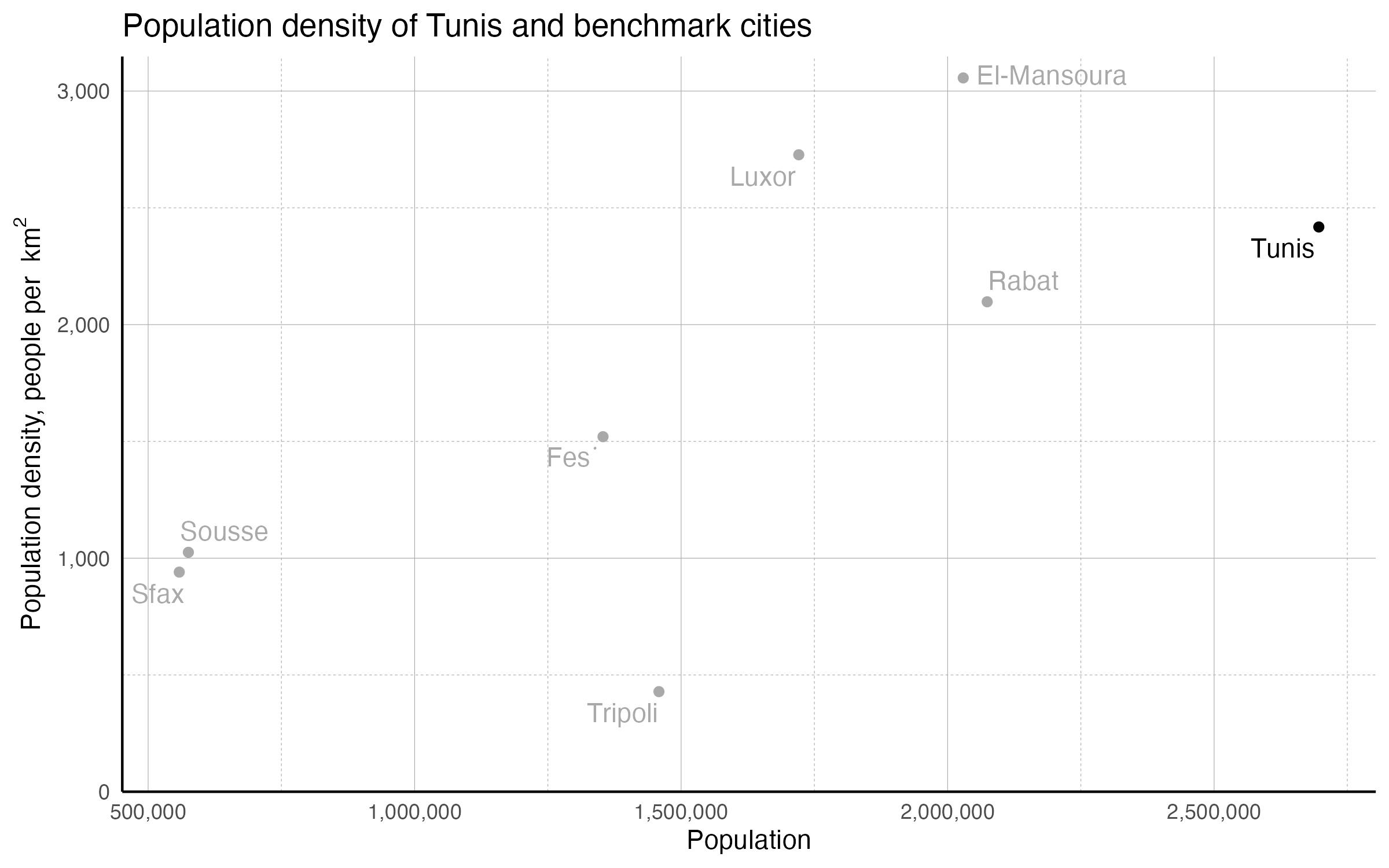
- With a population of 2.7 million and an area of 1,115 km2, Tunis has a density of 2,417 people per km2
- Of the benchmark cities, Tunis’ density is most similar to Luxor’s and Rabat’s
Density is calculated using the most recent census population recorded and the official land area occupied by the city, and is an important measure of how cities function. Higher population density enables governments to more easily deliver essential infrastructure and services in urban areas at relatively low cost per capita. However, such benefits do not materialize automatically or inevitably. Whether a city’s population dynamics pose challenges or offer opportunities typically depends on the policies in play.
Populations and area are from Oxford, 2022, “Oxford Economics” or CityPopulation.de. Note that Oxford Economics uses quite large extents for its cities, meaning that the measured density is likely considerably lower than the density experienced by most inhabitants of the cities. Extents used by the both data sources may differ from the AOIs used by the City Scans.
Economy
Cities’ Shares of National Population, Employment & GDP
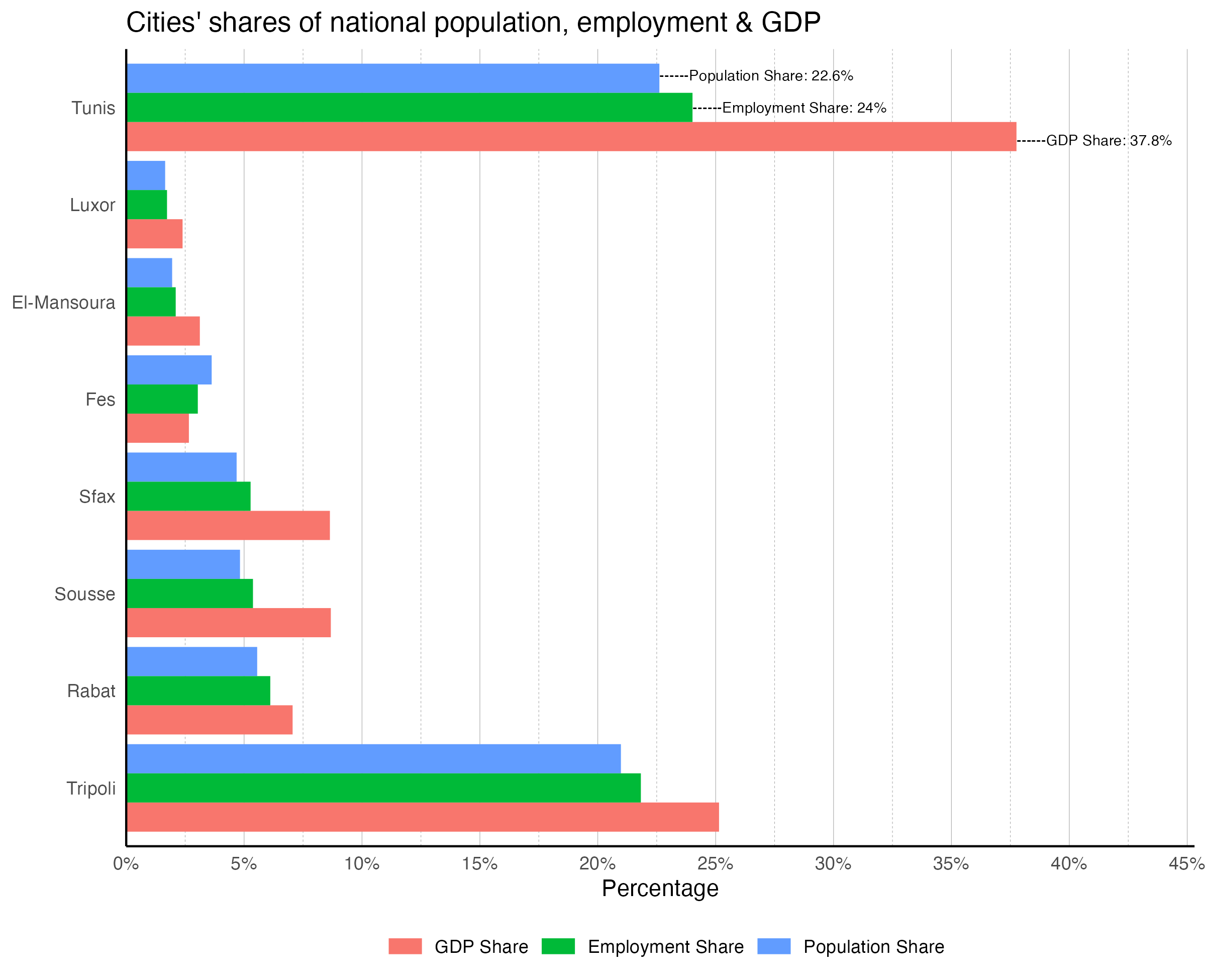
- Tunis represents just under a quarter of Tunisia’s population and total employment
- It represents a much larger share of the national GDP, at 38%
Urbanization and economic growth go hand in hand, in that higher levels of development are correlated with a greater concentration of production and population in cities. If managed well, cities:
- connect jobs and workers, allowing people to find employment that matches their skill sets;
- connect businesses with each other, allowing clusters of firms to share pools of labor and inputs, specialize and collaborate, and glean knowledge and ideas from others in their industry;
- connect urban residents to more extensive markets and increase their access to a variety of choices
Oxford, 2022, “Oxford Economics”.
GDP Growth
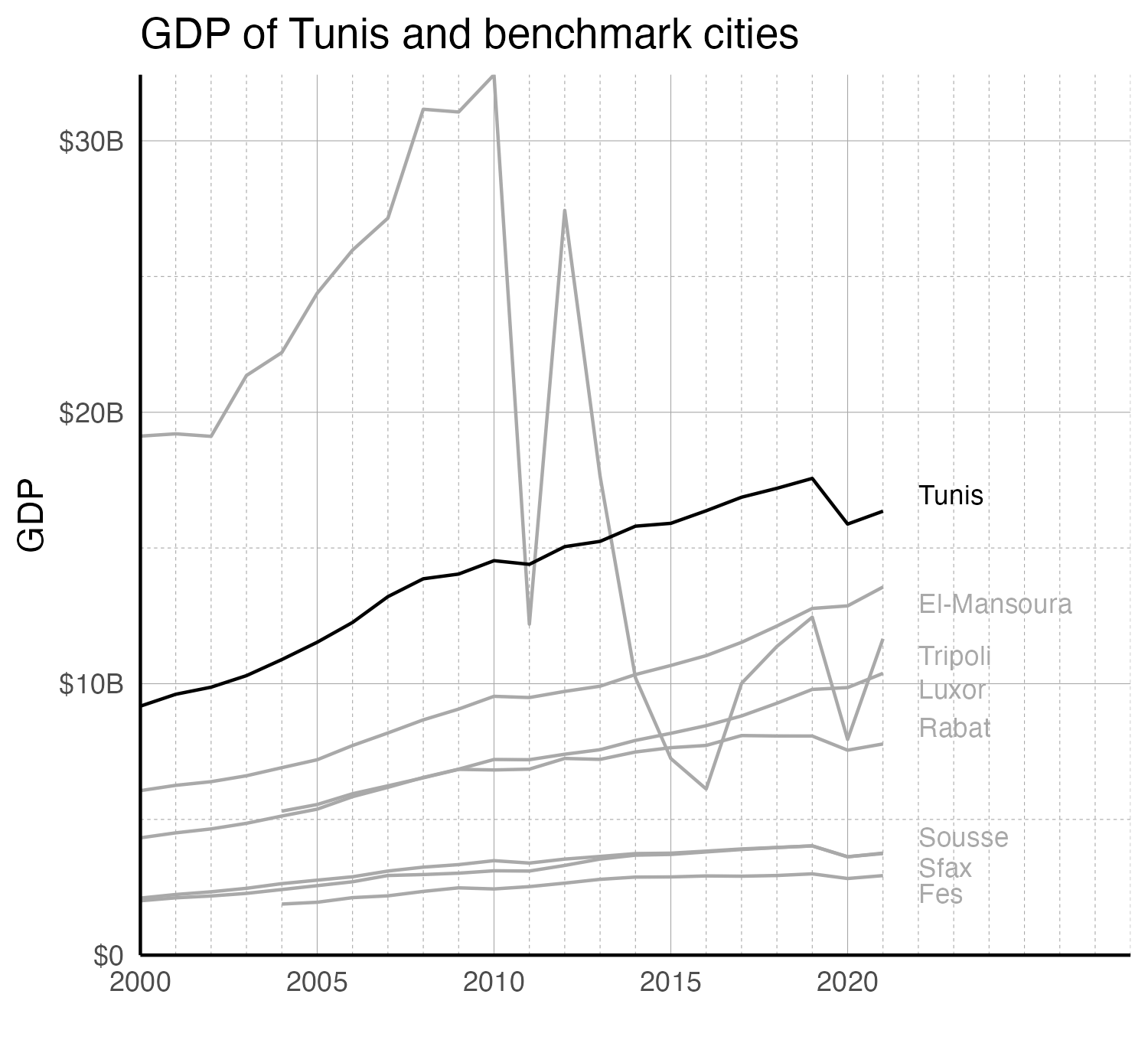
- Tunis’s GDP rose from USD 9.2B in 2000 to USD 16.4B in 2021
- Tunis’s GDP is most similar to that of El-Mansoura
- It had an average annual growth rate of 2.9%, similar to Sfax
GDP growth measures how fast the local economy is growing. Positive GDP growth is typically attributed to government spending, personal consumption, business investment, construction, and net trade.
Employment Growth
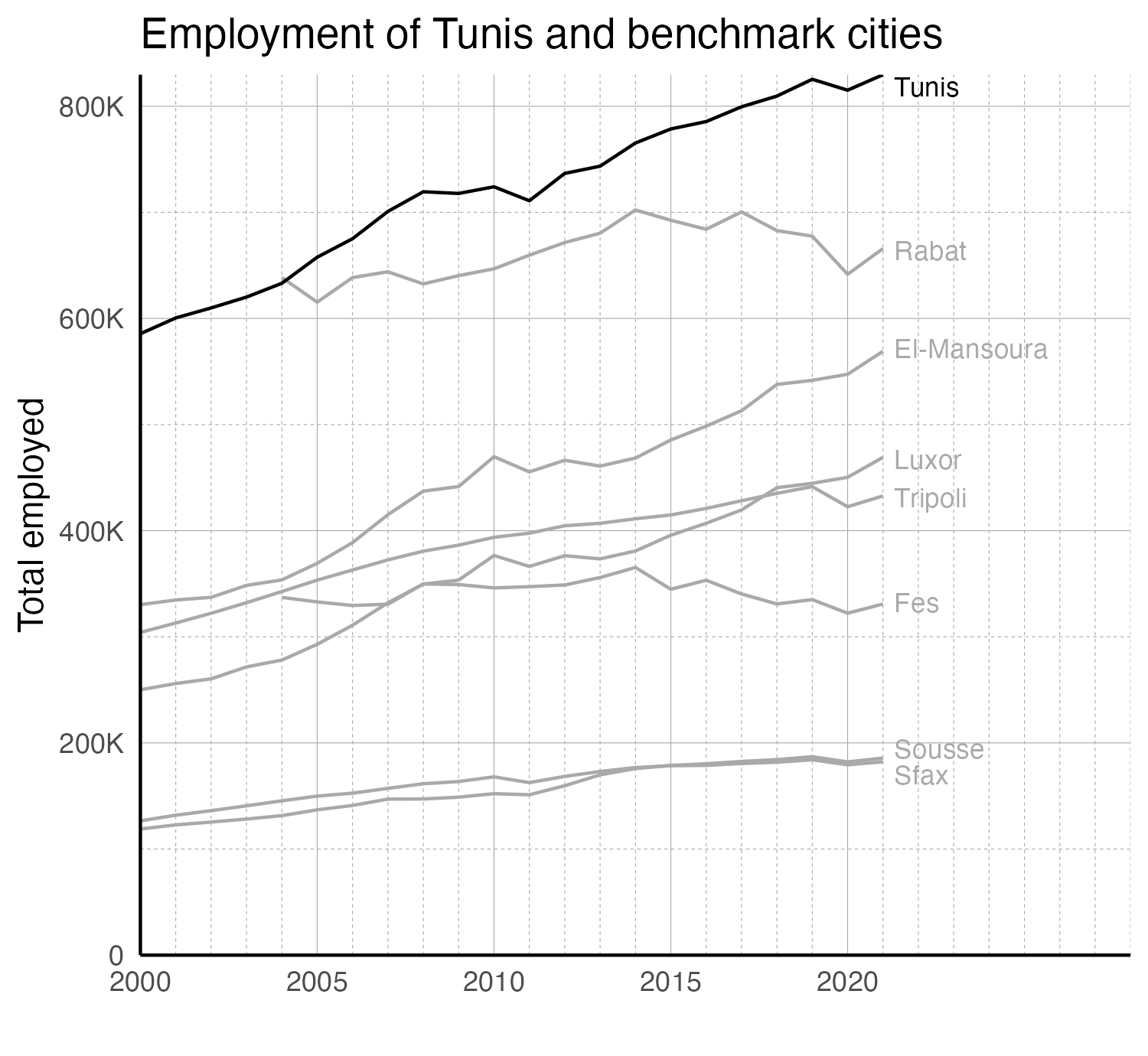
- Tunis employs 830,000 people
- While in 2000, Tunis and Rabat employed similar numbers, Tunis now employs far more people than Rabat (666,000 people)
- Between 2000 and 2021, Tunis’ employment numbers grew at an average annual rate of 1.7%
Employment growth is an indicator of expansion in the economy and represents an increase in the economic opportunities available to the citizens of a city.
Built Form
Climate Conditions
Risk Identification
Local Institutions and Planning
Administrative Structure
- The Tunis Governorate is divided into eight municipalities, one of which is the Municipality of Tunis
- Within the Municipality of Tunis, there are 15 municipal districts. These districts do not have independent decision-making authority or financial autonomy; instead, they operate within the broader framework of municipal governance
- The Municipality of Tunis is overseen by a municipal council composed of elected members responsible for local affairs such as budgeting, development planning, and service delivery
- However, the governor of the Tunis Governorate holds considerable influence over local governance, including the authority to challenge municipal council decisions and oversee matters related to budgeting and security
Availability Of Development Plans And Policies
- Tunisia’s urban and spatial planning is governed by a comprehensive regulatory framework, which includes the Land Use and Urban Planning Law, the Urban and Regional Development Code (Law No. 2003-78), and the Environmental Protection Law
- At the national level, the Ministry of Infrastructure, Housing, and Regional Development (MEHAT) plays a key role in implementing urban development policies and overseeing major infrastructure projects
- The Cities Alliance Country Programme is supporting the Tunisian government in developing a National Urban Policy aimed at establishing a unified and coherent framework for managing urban growth across local, regional, and national levels
- At the local level, this programme is supporting municipalities like Tunis to develop and implement city development strategies (CDS), including building capacity in strategic urban planning and gender-sensitive approaches
The State of Urban Infrastructure and Service Delivery
Land Administration
Tunisia’s land administration system is overseen by several key institutions and actors. Its legal framework has gradually evolved to incorporate elements of Islamic land law, colonial-era legislation, and modern statutes introduced since independence in 1956. Responsibility for land registration is shared among the Real Estate Court, the Department of Topography and Cartography, and the Land Registrar (Conservateur). Land use planning, on the other hand, falls under the jurisdiction of the Ministry of Public Works, Housing, and Land Use Planning.
Energy
Tunisia has a well-developed energy sector, however it continues to rely on imports from Algeria and Libya to meet its overall energy demand. In an effort to reduce this dependency, the country is actively transitioning to renewable energy, setting ambitious targets to generate 35% of its electricity from renewables by 2030 and 50% by 2050. These goals are part of a broader national strategy to cut greenhouse gas emissions and diversify energy sources, with a particular focus on expanding solar and wind energy investments. Additionally, the government has launched a National Green Hydrogen Strategy, aiming to produce 8.3 million tonnes of green hydrogen and its derivatives annually by 2050.
Housing
Tunisia is a highly urbanized country, with 70% of its population residing in urban centers as of 2021. In recent years, however, the country has faced growing challenges in urban housing, largely due to rising land and construction costs and the limited effectiveness of public social housing programs. The government has introduced several initiatives to address these issues, including the Housing Promotion Fund for Employees with Limited Salaries (FOPROLOS), which supports the construction of new homes, and the National Housing Improvement Fund (FNAH), which provides loans for renovations. Despite these efforts, the housing needs of low-income households remain largely unmet. As a result, informal settlements and slums have expanded, now housing around 10% of the urban population.
Disaster Risk Management
Disaster risk management (DRM) in Tunisia is guided by a legal framework established under Law No. 91-39, which mandates the formation of national and regional commissions to develop and implement disaster prevention and management plans. The Ministry of Interior oversees the overall disaster management system, while the National Office of Civil Protection (ONPC) plays a key role in disaster preparedness and response. Traditionally, Tunisia’s DRM approach has been largely reactive, focusing on disaster response. In recent years, however, authorities have been working to adopt a more proactive and comprehensive strategy. Led by the Ministry of Local Affairs and Environment (MALE), these efforts aim to align national policies with the Sendai Framework for Disaster Risk Reduction through a multi-risk approach. An Action Plan is currently being developed, outlining short-, medium-, and long-term measures for the 2026–2030 period. However, the new strategy has not yet been formally adopted.
Drinking Water Supply
Water resources in northern Tunisia are plentiful, largely due to a dense network of rivers. By 2011, access to safe drinking water had become nearly universal—reaching almost 100% in urban areas and around 90% in rural regions. The Sociéte Nationale d’Exploitation et de Distribution des Eaux (SONEDE), an autonomous public authority under the Ministry of Agriculture, oversees water supply systems in urban centers and major rural areas, including Tunis. Despite these achievements, Tunisia faces growing challenges. Worsening drought conditions and significant environmental pollution are increasingly threatening the country’s freshwater resources. Additionally, Tunisia relies heavily on seasonal rainfall to meet its water demands, however unpredictable and fluctuating rainfall patterns have made water availability even more scarce.
Urban Roads & Transport
Tunis has a well-developed public transportation system that includes a wide-reaching bus network operated by the Société Nationale de Transport Interurbain (SNTRI), covering over 200 routes. The city is also served by the Tunis Light Metro, a light rail system launched in 1985, which now spans 45.2 kilometers with six lines and 80 stations. Complementing this network is the TGM commuter rail line, which links central Tunis to the northern suburb of La Marsa. Despite this extensive infrastructure, the city frequently experiences heavy traffic congestion. Additionally, roads leading out of the city are often poorly maintained.
Solid Waste Management
Waste management in Tunis is overseen by the Agency for the Management of Solid Waste in the Greater Tunis Area (AMTVD), which is responsible for operating landfills and waste processing facilities across the region’s municipalities. Tunisia has established a comprehensive legal framework for waste management, including Law 1996-1941, which governs waste disposal and promotes recycling and composting. Despite this framework, the country faces major challenges. Overflowing landfills and insufficient waste collection—particularly in rural areas—pose risks to public health and sanitation. Additionally, recycling rates remain low and are largely sustained by informal waste pickers.
Local Administration
Tunisia is divided into 24 governorates, each of which is further subdivided into 264 delegations, and these delegations are then divided into sectors and municipalities. Municipalities, known as baladiyat, are the primary local government units, responsible for managing local affairs such as budgeting and development planning. However, despite constitutional provisions aimed at enhancing decentralization and local autonomy, municipalities have limited powers and are subject to central authority. The 2014 Constitution introduced regions as a higher administrative level, comprising multiple governorates, but their role is still evolving.
Land Administration: Arab Land Initiative, N.D. Housing: Center for Affordable Housing Finance in Africa, N.D. Energy: GH2, N.D.; Energy Capital & Power, 2025; Transformers Magazine, 2024. Disaster Risk Management: European Union Civil Protection, 2018; UNDRR ReliefWeb, N.D. Water: DevelopmentAid, 2024; Wikipedia, N.D. Solid Waste Management: Abdulrahman, A., 2017; WTERT, N.D. Roads and Transport: Trip Report, N.D. Local Administration: European Committee of the Regions, N.D.
Key Considerations for Investment Planning & Prioritization
Concluding Questions
What is the most surprising result for you in this City Scan?
What patterns did this City Scan illuminate that you had not considered before?
What are your city’s critical development challenges?
What other information would you like in order to corroborate or amplify the information in this City Scan?
Who else would you like to speak with to gain further understanding about your city’s development challenges?
What investments need to be prioritized? What trade-offs are inherent in your prioritization?
What investments could be coordinated? What benefits would such coordination bring?
Last edited 2025-06-17.
This City Scan is a product of the City Resilience Program.
The findings, interpretations, and conclusions expressed in this City Scan do not necessarily reflect the views of the World Bank, the Executive Directors of the World Bank, or the governments they represent. Given that the data included in this work are derived from global sources, the World Bank does not guarantee its accuracy.